The Rice Cooker Kind of Solitude
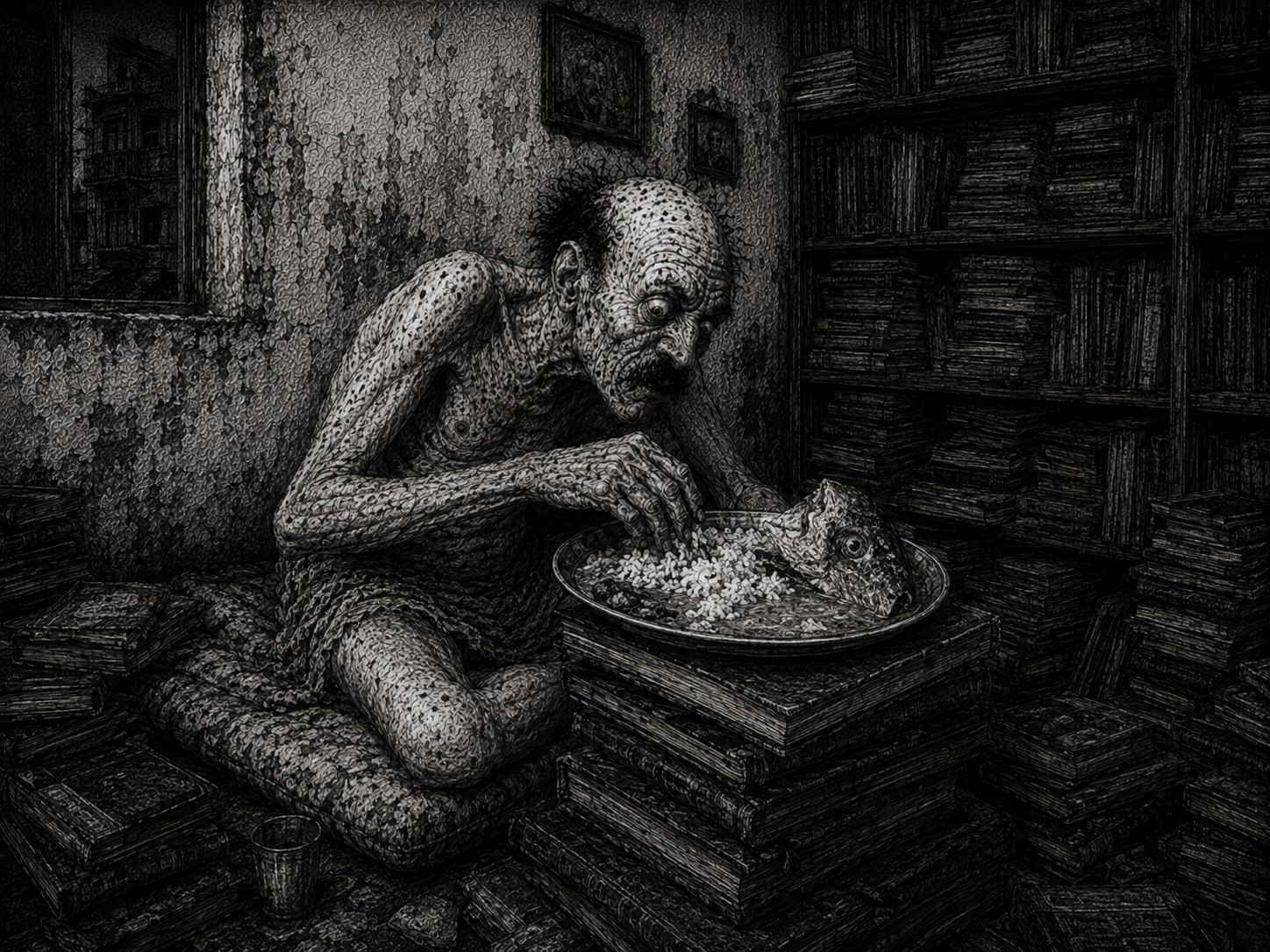
Acronyms used in this post:
CPU: Central Processing Unit, the main chip inside a computer that carries out instructions.
SQL: Structured Query Language, the language used to ask questions of relational databases.
VA: Veterans Affairs, the American federal healthcare system for military veterans.
NIH: National Institutes of Health, the major American government agency that funds and conducts biomedical research.
Wi-Fi: Wireless Fidelity, the wireless network connection that now sits in rooms like an invisible household god, except cheaper and more irritable.
The rice cooker clicks in the corner with a small wet sound, the sort of sound no poet has ever respected, though poets have wasted entire afternoons praising rainwater on leaves, moonlight on ponds, and other things that do not have to clean themselves afterward.
It is not a grand kitchen sound.
Not the ancestral Bengali kitchen sound where fish is cleaned with a boti, mustard oil rises like a political ideology, and some elderly uncle argues about Hilsa prices as if the Padma, the Ganga, the finance ministry, and the United Nations have all betrayed him personally.
No.
This is the modern bachelor sound.
Plastic lid. White steam. One red light. One switch. One man on a mattress pretending that this arrangement is temporary, though the room has begun to suspect otherwise.
The rice cooker sits sometimes on the shabby unkempt kitchen counter and more frequently these days on the floor beside a laptop charger, a coil of wire, two unpaid bills, one damp towel, and a smell that cannot be honestly blamed on the municipality. It coughs steam like a clerk in a government office who has sinus trouble and knows your file is missing but will not say so.
That is solitude.
Not the mountain-top kind.
Not the saffron-cloth, bell-ringing, ancient-India brochure kind, where some bearded holy man sits under a tree and turns constipation into philosophy.
This is the other kind.
The rice cooker kind.
The kind where the room knows too much.
A single man in a small rented room is not alone in any clean or heroic way. He is accompanied by every unfinished thing. The laptop sits there like a dead pet. The bills lie flat and white, thin ghosts with printed numbers. The mattress performs the democratic duty of bed, sofa, dining table, hospital cot, courtroom, depression raft, and occasionally, when dignity has gone downstairs to smoke a cigarette and not returned, dining room.
The ceiling fan rotates above.
Round and round.
No decision.
No progress.
Just circulation.
It has the moral energy of a file moving between two departments in Writers’ Building.
And the heat arrives.
Actually, no. That is wrong. Heat does not arrive in Calcutta. Heat occupies. Heat takes possession. Heat comes in wearing a lungi, sits on your neck, and says, “Let us now see what remains of your ambition after lunch.”
In other places, heat is temperature. In Calcutta, heat is a legal notice served by physics. The molecules in the air do not merely vibrate. They crowd. They shove. They complain. Brownian motion, that nice little dance Robert Brown noticed in pollen grains in 1827, becomes by June a full minibus fight near Garia, with everyone trying to board at the same time and nobody admitting there is no space.
You sit there unemployed, half-employed, or consulting in that special Indian manner where payment is treated like a mythological event. One hears about it. One believes it happened long ago. One has not personally seen it.
Then the rice cooker clicks off.
Done.
Food is done.
Life is not.
That is the cruelty of machines. They finish.
The rice cooker finishes rice. The phone finishes charging. The fan completes one rotation and begins another. Even the pressure cooker, that middle-class bomb with self-esteem issues, has the courtesy to whistle.
But a man can remain half-cooked for years.
Half-paid.
Half-loved.
Half-bathed.
Half-ready.
Half-dead.
Emotionally parboiled. Not raw enough to begin again. Not cooked enough to serve.
People praise solitude when they have return tickets.
That is the trick.
The wealthy man says he needs solitude, then goes home to wife, child, dog, calendar, dinner reservation, airport lounge, and somebody asking whether he took his medicine. The professor says solitude nourishes the mind, then returns to a stocked fridge and a spouse who is angry about the plumber. The poet writes about loneliness in a room with linen curtains and European light, and somewhere in the background there is probably soup.
Practical isolation is not poetic.
It is logistical.
Do I have enough rice for tonight? Enough mobile data? Enough money left after the electricity bill? Enough clean underwear? Enough emotional energy to call the electrician? Enough shame left not to call anybody? Enough pride left to pretend I am not lonely?
That is the daily examination.
No invigilator.
No answer sheet.
No grace marks.
People also think solitude is silence. This is another lie sold by people who have never lived beside a pressure pump.
A small room is loud. The sound is simply not human. Ceiling fan. Transformer. Motorbike. Dog. Water pump. Neighbor dragging furniture at midnight as if rearranging the skeleton of a buffalo. Plastic bucket expanding in the heat with a small criminal pop. Phone notification from an app pretending the world has remembered you, when actually there is only a discount on something you cannot afford.
But the largest noise is not acoustic.
It is social absence.
It is the huge invisible racket of not belonging to anyone’s daily necessity.
Nobody needs to know whether you ate.
Nobody is irritated because you forgot coriander.
Nobody asks why your face looks like spoiled atta.
Nobody says, “Come early.”
Nobody says, “Don’t be late.”
Nobody adjusts dinner because of you.
Nobody’s medicine depends on your return.
Nobody’s mood rises because your key turns in the lock.
This makes a sound.
A large one.
It is like the old cosmic microwave background, that faint leftover hiss from the early universe, only cheaper and more personal. In 1965, Arno Penzias and Robert Wilson found that strange microwave noise while trying to understand their antenna, and for a while they suspected pigeon droppings. This is science at its most honest and Bengali: two men staring at bird mess and accidentally finding the baby photograph of creation.
My room also has background radiation.
Not 2.7 kelvin.
More like 36 degrees Celsius, with a smell of stale rice, old books, damp cloth, and male postponement.
It hums one word.
Unnecessary.
Not unloved. That is too dramatic. Too cinema. Too much violins and rain on window glass.
Unnecessary is worse.
Unnecessary is a spare cable in a drawer. A cracked mug. A duplicate key to a lock that has been changed. An old remote control for a television that died in 2019. You still exist, yes. Congratulations. Have a biscuit. But the system no longer calls your function.
In computer terms, and I have spent enough of my life among systems to recognize the smell of a dead process, you are a service no longer invoked by any active application. The daemon is running. The logs are accumulating. The CPU is warm.
No request arrives.
And when no request arrives from outside, the mind begins generating traffic of its own.
That is when the little committee inside starts.
Memory opens like a clogged drain.
School corridors. Report cards. Old praise. Teachers saying bright boy. Relatives smiling with that Bengali optimism which is often just astrology wearing spectacles. Entrance ranks. University gates. America. Fluorescent labs. Hospital corridors. SQL queries. VA systems. NIH studies. The clean American terror of competence, where at least if you failed, the machinery around you did not smell of damp socks, paan spit, and someone else’s frying oil.
Then return.
Then India.
Then the long grinding comedy of being educated beyond your usefulness in a country where honesty is treated as a personality defect and payment has to be hunted like a shy forest animal.
Then the room.
Always the room.
The room waits like a mouth.
It eats days.
A small room is not small in the geometric sense. Euclid would measure it and be finished, the tidy fellow. Length, breadth, area, volume, diagram, done. But lived space is not so obedient. Depression bends it. Debt bends it. Heat bends it. Shame bends it.
The bathroom may be five feet away, but on a bad morning it is the Himalayas.
The laptop may be two feet away, but the file you must open sits behind mountains, police checkpoints, angry monkeys, and one small corrupt official demanding paperwork in triplicate.
People who live in families often misunderstand the acoustics of the unshared room.
They think loneliness means wanting company.
Not quite.
Wanting company is the polite version. That is the version with clean shirt, combed hair, and tea served in cups.
Real solitude begins when the body loses the habit of being witnessed. You scratch more honestly. You talk to utensils. You negotiate with dirty plates. You become king, sweeper, finance minister, opposition party, and unpaid watchman of a kingdom whose entire economy is tea, rice, electricity, and dread.
A full day can pass without speech.
Then the delivery boy calls.
You answer.
Your voice comes out like an old wooden door opening in a haunted zamindar house.
Even then, some stupid mammalian part of the brain persists.
The human nervous system was not designed for this bachelor warehouse arrangement. We are primates with rent agreements. The body expects tribe, fire, gossip, shared food, someone noticing fever, someone asking why the cough has changed, someone saying the tiger is behind you, look alive.
Evolution did not prepare a man to sit alone with broadband, debt, and a YouTube algorithm.
The amygdala, that little almond-shaped panic accountant in the brain, still scans for abandonment as if abandonment were a leopard. Cortisol rises. Sleep breaks. Appetite becomes either a dead switch or a municipal garbage truck. The gut, which has its own nervous system and a personality more dramatic than most actors, begins sending telegrams to the brain.
Situation poor.
Morale low.
Send fried egg.
This is why solitude becomes bodily.
It is not an idea.
It is stomach.
It is scalp.
It is the sour smell in the pillow.
It is waking at 3:40 a.m. to urinate and finding the room briefly unfamiliar, as if some other failed man has been living there and you are only visiting his ruin.
The old monks at least had bells.
I have a rice cooker.
They had manuscripts.
I have unfinished work.
They had disciples.
I have spam.
They had God, which is a great advantage in this business, because imaginary company is still company if you can manage the belief.
I have atheism, which is intellectually cleaner but domestically useless. Atheism will not ask whether the gas cylinder is empty. Rationalism will not sit beside you during fever. The scientific method, noble and sharp as a new blade, will not say, “Eat something, you miserable creature, you are becoming strange.”
So the day narrows.
Tea.
Laptop.
Heat.
Rice.
Bill.
Mattress.
Fan.
A message typed and deleted.
A plan postponed.
A memory picked at like a scab.
Outside, the city continues its vast public indigestion. Vendors shout. Autos cough. Political flags fade in dust. Men stand at tea stalls with the grand confidence of people who have not read enough to damage themselves. Somewhere, a man is late for someone. Someone is bringing medicine. Someone is buying fish for a mother. Someone is being scolded by a wife and secretly enjoying the proof that he matters. Someone is lying successfully.
Inside, I sit with my plate on my lap, mixing dal into rice, feeling the steam touch my face like a weak blessing from a universe that has other work.
The fish bone waits.
The phone glows.
The fan turns.
The rice cooker, having completed its duty, sits in the corner with the smug peace of a creature that knows its purpose.
And the room, this hot little coffin with Wi-Fi, keeps making its enormous noise while I chew carefully, because even choking to death alone would create paperwork, phone calls, questions from neighbors, and perhaps one final unpaid bill.